intro

Hair Transplant Surgery

Hair transplantation is a minimally invasive medical-surgical procedure designed to restore areas of the scalp with low density or complete hair loss.
At IDC.Clinic, we use the most advanced techniques — FUE (Follicular Unit Extraction) and DHI (Direct Hair Implantation) — to ensure natural, long-lasting, and safe results. The procedure is performed under local anesthesia and leaves no visible scarring, making it ideal for patients seeking a definitive solution to hair loss.

Book appointment

Treatments / Procedures

What Is a Hair Transplant?

The procedure is completed in a single day and consists of three main stages:

Diagnosis and Pre-Surgical Consultation

Before the intervention, the patient undergoes a detailed medical consultation. This includes a scalp assessment, evaluation of the donor area, and a customized design of the hairline for implantation. The consultation also reviews the patient’s medical history, screens for contraindications, and includes the request for blood tests.
Hair Transplant Procedure

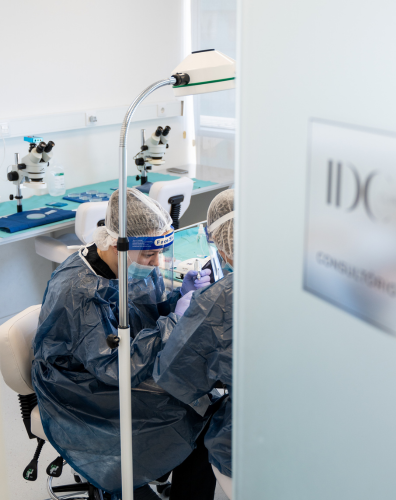
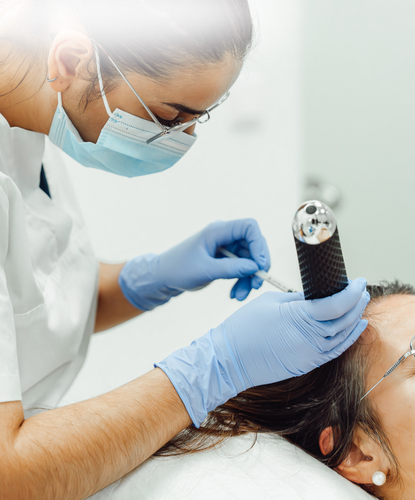
Under local anesthesia, the medical team begins the individual extraction of follicular units from the donor area (usually the occipital and lateral regions). The extracted units are classified and prepared under a microscope. Then, the hair follicles are implanted one by one in the recipient area (temples, crown, or top of the head), with utmost precision in angle, direction, and depth.
Personalized Follow-up

The clinical follow-up is rigorous and long-term. If the patient wishes, the first post-operative wash can be performed at the clinic on Day 5. Follow-up appointments are scheduled at 1, 6, 12, and 18 months, with photographic documentation of progress. The final result is typically visible between 12 and 18 months after the procedure.
After surgery, proper care is essential to ensure optimal results and prevent complications. During the first month, the patient should:

  • Avoid touching or scratching the implanted area.
  • Sleep with the head elevated for the first few nights.
  • Apply saline solution as instructed by the medical team.
  • Avoid wearing hats or helmets for the first 10 days.
  • Refrain from intense physical activity, sun exposure, or hot showers.
  • Avoid alcohol, tobacco, and non-prescribed medications.

The medical team will provide a comprehensive post-operative care plan tailored to the patient’s clinical needs.

  • Natural results, with a customized hairline and no visible scarring.
  • Advanced FUE/DHI technique offering surgical precision with minimal trauma.
  • Permanent solution, with hair regrowth in the implanted areas.
  • Quick recovery, no hospitalization required, and minimal post-operative discomfort.
  • Specialized medical supervision throughout the entire process.

Considering a Hair Transplant?

At IDC.Clinic, hair transplants are performed by a highly experienced team using the most advanced techniques and equipment, always prioritizing natural appearance and patient safety.

Book a consultation to assess your suitability, clarify any doubts, and receive a treatment plan adapted to your needs. Still unsure? Browse our clinical case gallery and see real before-and-after images from patients. The results speak for themselves.

Results

Faqs

Hair transplantation is suitable for men and women with androgenetic alopecia or other forms of localized hair loss. A healthy donor area (usually the sides and back of the head), good general health, and realistic expectations are essential. A medical evaluation is mandatory before the procedure.

FUE (Follicular Unit Extraction) enables individual follicle extraction without linear incisions, avoiding visible scarring. Compared to older methods like FUT (Follicular Unit Transplantation), which involves removing a strip of scalp, FUE offers faster recovery, greater comfort, and more natural results.

No. The transplant is performed under local anesthesia, and the patient remains awake throughout, without feeling pain. Mild discomfort may occur in the hours following the procedure and is easily managed with light analgesics.

In the first few days, avoid:

  • Physical exertion
  • Tight hats or caps
  • Direct sun exposure
  • Sleeping on the side or rubbing the implanted area
  • Using non-approved hair products

Strict adherence to medical guidelines ensures proper healing and graft fixation.

Around the first month, transplanted hairs typically fall out in a normal process called “shedding,” as the follicles regenerate. From the 3rd month, a new growth phase begins, with visible results by the 6th month. Final results stabilize between 12 and 18 months.

No. Although initial shedding is expected, the implanted follicles remain active and produce new hair with the same resistance to loss as the donor area. Native hair may still thin over time, so ongoing medical follow-up is advised.

Yes. In some cases, a second transplant may be necessary, especially for large areas or progressive hair loss. The medical team will determine the best approach based on the type of alopecia and donor density.

Yes. It is contraindicated in active autoimmune diseases, scalp infections, severe coagulation disorders, or the absence of a viable donor area. It is also unsuitable for patients with unrealistic expectations or psychological conditions that may affect perception of the results.

FUE allows the extraction of follicular units individually from the donor area, without linear cuts or stitches. Unlike FUT, which removes a strip of scalp, FUE leaves only tiny, almost invisible micro-scars and offers faster, more comfortable recovery. It also provides greater naturalness and flexibility in hairline design.

SPECIALTIES

We use high-quality materials and techniques, as well as different protocols, to ensure the best results.
